
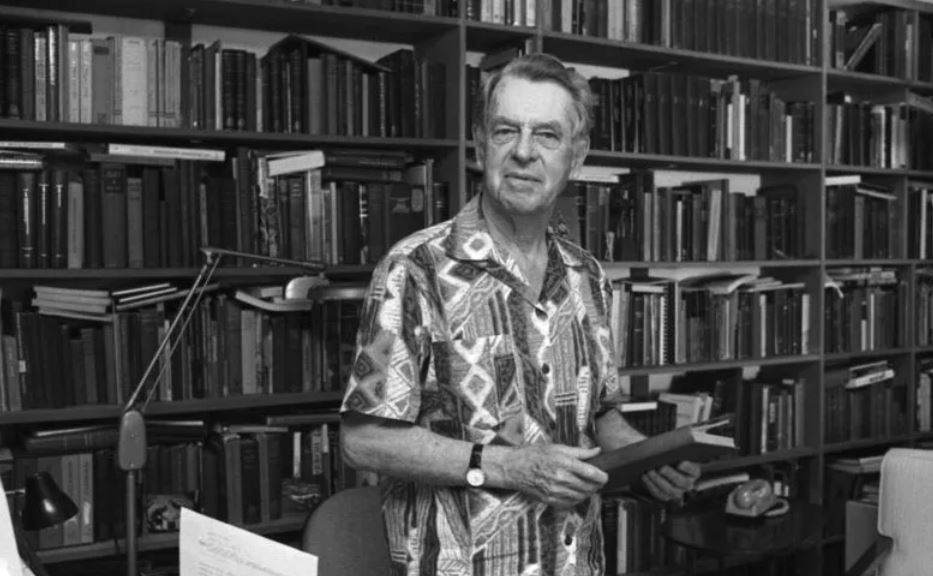
“We are at this moment participating in one of the very greatest leaps of the human spirit to a knowledge not only of outside nature, but also of our own deep inward mystery.”—Joseph Campbell
While Joseph Campbell lived, he was considered as perhaps the most important scholar of the mythologies of the world. His seminal work in this regard, “The Hero With A Thousand Faces,” was first published in 1949, with some additional material being added in a second edition in 1968. Within its pages, the reader can gain a wealth of knowledge and insight into the importance of mythology, as well as a detailed description of the many different aspects of the ancient mythological tales.

The real benefit of having pursued his life’s work all those years came when he agreed to be interviewed by PBS’s Bill Moyers, in a series called, “The Power of Myth.” The interviews were conducted in 1985 and 1986, shortly before Campbell died in October 1987, and the television series and the book of the same title came out in 1988.
The PBS series, broadcast in six one-hour episodes, consisted of an edited version of 24 hours of conversation. Reading at length in the book gives a much broader selection from those interviews and I recommend it highly to anyone wishing for an even greater insight into his work.
One quote in particular caught my attention as it includes several of the keywords from the title of my blogpost:
“The myths are metaphorical of spiritual potentiality in the human being, and the same powers that animate our life animate the life of the world…The individual has to find an aspect of myth that relates to his own life…Myth serves a mystical function (and) opens the world to the dimension of mystery, to the realization of the mystery that underlies all forms…(and) a cosmological dimension…showing you what the shape of the universe is, but showing it in such a way that the mystery again comes through…(and) a sociological one—supporting and validating a certain social order.”
Campbell was, himself, a prolific writer, teacher, lecturer, and scholar, and even though his many books, essays and speeches were filled with selections from the important writings of philosophers, artists, and a whole variety of prominent religious and secular figures of history, according to Moyers, his true talent wasn’t in his robust scholarship:
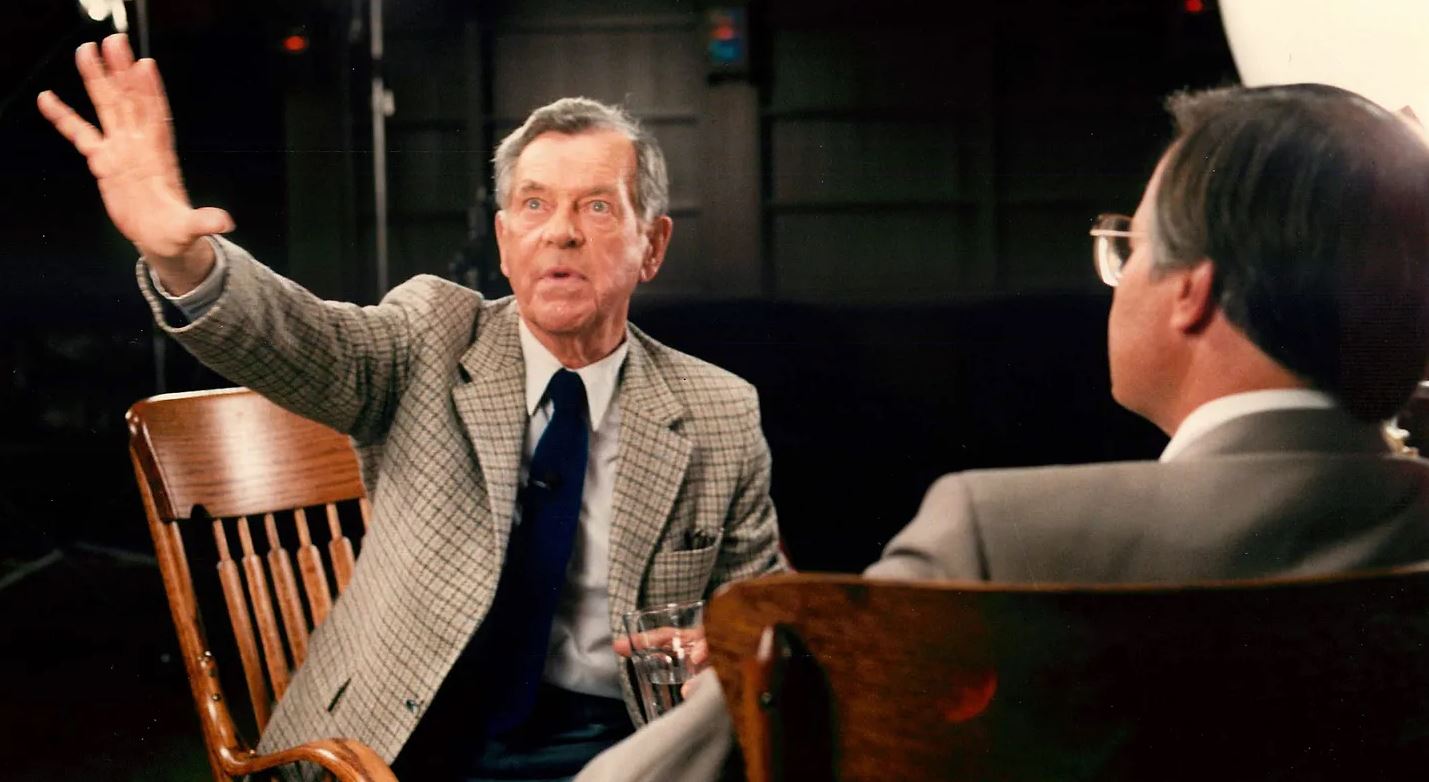
“I never met anyone who could better tell a story. Listening to Joseph Campbell talk of primal societies, I was transported to the wide plains under the great dome of the open sky, or to the forest dense, beneath a canopy of trees, and I began to understand how the voices of the gods spoke from the wind and thunder, and the spirit of God flowed in every mountain stream, and the whole Earth bloomed as a sacred place—the realm of mythic imagination.”
Indeed, many of the lectures and seminars which Campbell gave throughout his career contain so many treasures for the curious and the inquisitive mind, that a large collection of his work was assembled by Diane K. Osbon, called “Reflections on the Art of Living: A Joseph Campbell Companion.”
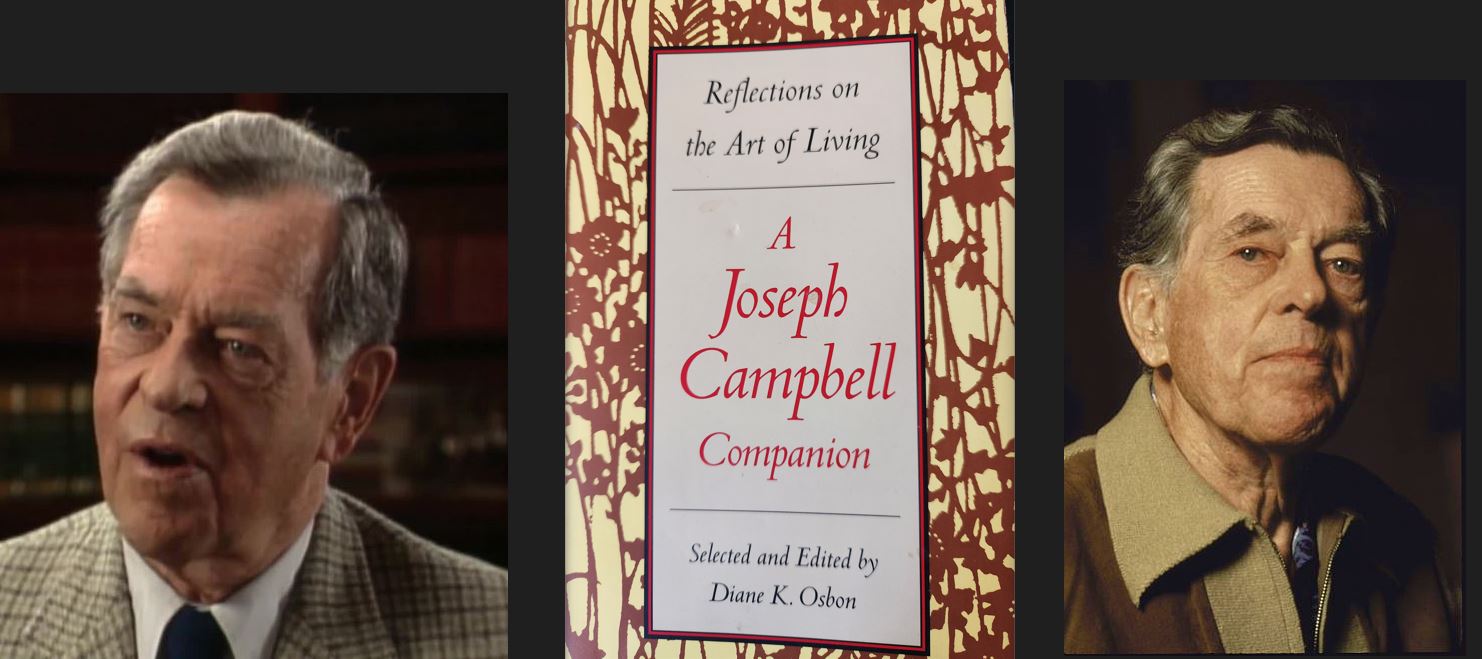
Joseph Campbell, the man, led an extraordinary life in the 83 years he lived, and in his recounting of his early life, he acknowledged his humanity, and did not seem to recognize that he had become a legend:
“My parents never pushed me around. I had special luck there. By the time I was invited to teach at Sarah Lawrence, I had decided that I didn’t need a job and did not want one. It would interrupt my reading…When I finally got that job, I was thirty years old, and Dad said, ‘Joe, I thought you were going to be a literary bum.’ But until I got the job, he never said a word. He was a good father. When ‘The Hero With A Thousand Faces’ came out, he said, ‘I prophesy this is going to be a wonderful book.’ He hadn’t read a word of it, but he knew his boy had done it.”
Campbell’s life was dedicated to understanding the value and essential nature of mythology, and his writings often contain important ideas to ponder:
“The best things can’t be told because they transcend thought. The second best are misunderstood, because those are the thoughts that are supposed to refer to that which can’t be thought about. The third best are what we talk about. And myth is that field of reference to what is absolutely transcendent.”
For me, one particularly important passage speaks about the nature of dreams as it relates to myth:
“…a dream is a personal experience of that deep, dark ground that is the support of our conscious lives, and the myth is the society’s dream. The myth is the public dream and the dream is the private myth.”
Next time: The Mystery of Miracles
 John's Consciousness
I too thought that was an interesting PBS series. I recall a particular sequence where Campbell utterly mystified Moyers, who is an earnest and striving journalist, Moyers, who had a religious familial upbringing, with which he was trying to grapple, had asked Campbell to try to correlate the religious life with the pursuit of the mystical, or mythical. And Campbell thought a moment and replied that the main problem with religions is that they work against real religious experience. I understood this at once, but Moyers was befuddled.
Yes, and Campbell went on to explain at length how religions “are addressing social problems and ethics instead of the mystical experience.” As someone with a similar religious background to Bill Moyers, even when I was an adolescent, I knew that my experiences were outside of the rituals and doctrines of my religion, but I was encouraged to stick with the doctrines by most of the clergy. I can appreciate his confusion. Campbell wrote extensively about the mystical experience, and recognized that the symbolic expressions of it “don’t render the experience, they (only) suggest it.”
In my view it is not even that instituted religions do not facilitate spiritual experiences; it is that they can’t. Campbell’s explication of the mythic Hero within the series is of necessity a lone figure, on an individualized journey. Religions are not for individual seekers but for groupwise orthodoxy around ‘received’ doctrine. This is why they are faltering. Because the needs of the times demand commitments to personalized journey without respect to dogma guidelines.
It seems reasonable to me that any such experience can only be truly confirmed and facilitated by the individual subjectively, but each of the major instituted religions and spiritual practices have produced individuals who are described as “mystics,” who have shared their knowledge and experiences with others. The instituted religions themselves may not facilitate the actual experiences, but individuals within those organizations, over the millennia, have reported such experiences, even though such affiliations aren’t necessary or able to facilitate them.
In my view, we are the ones who facilitate our own experiences and, as individuals, we can only recognize them for what they are subjectively. My guess is that the issue of why they are faltering has a number of additional causes, aside from those discussed in this context.
Thanks for your thoughtful comments…John H.
Yes that is correct. I agree. I think the answer is that institutional religions discourage individuality, namely by proscribing beliefs and interpretations. The mystic or initiate must either break out of those boundaries or not be subjected to them initially. The break out has something to do with independently developing perceptions in accordance with more symbolic meanings of sacred texts than literal ones (which have been dogmatically imposed through orthodoxy or laziness).
I think it is less the case that each major religion produced an initiate than that each has served as a launching springboard for various rare individuals to persist in questioning and overcome its limitations.
I’ve heard of Joseph Campbell and his myth book, but don’t know much about him. Absolutely loved reading this! I’ll have to check him out more. Thanks for sharing.
Thanks for visiting here and for sharing such thoughtful comments. I truly appreciate your interest in Campbell and do recommend his writings wholeheartedly. In much the same way as you write on your blog, I have had a fairly tumultuous spiritual journey and have endured struggles that tested my resolve to continue. I admire your tenacity and wish for you every success. Your blog is heartfelt and honest and that is a rare commodity these days.
Kind regards…John H.
That means a lot to hear. Thank you for your kindness!