
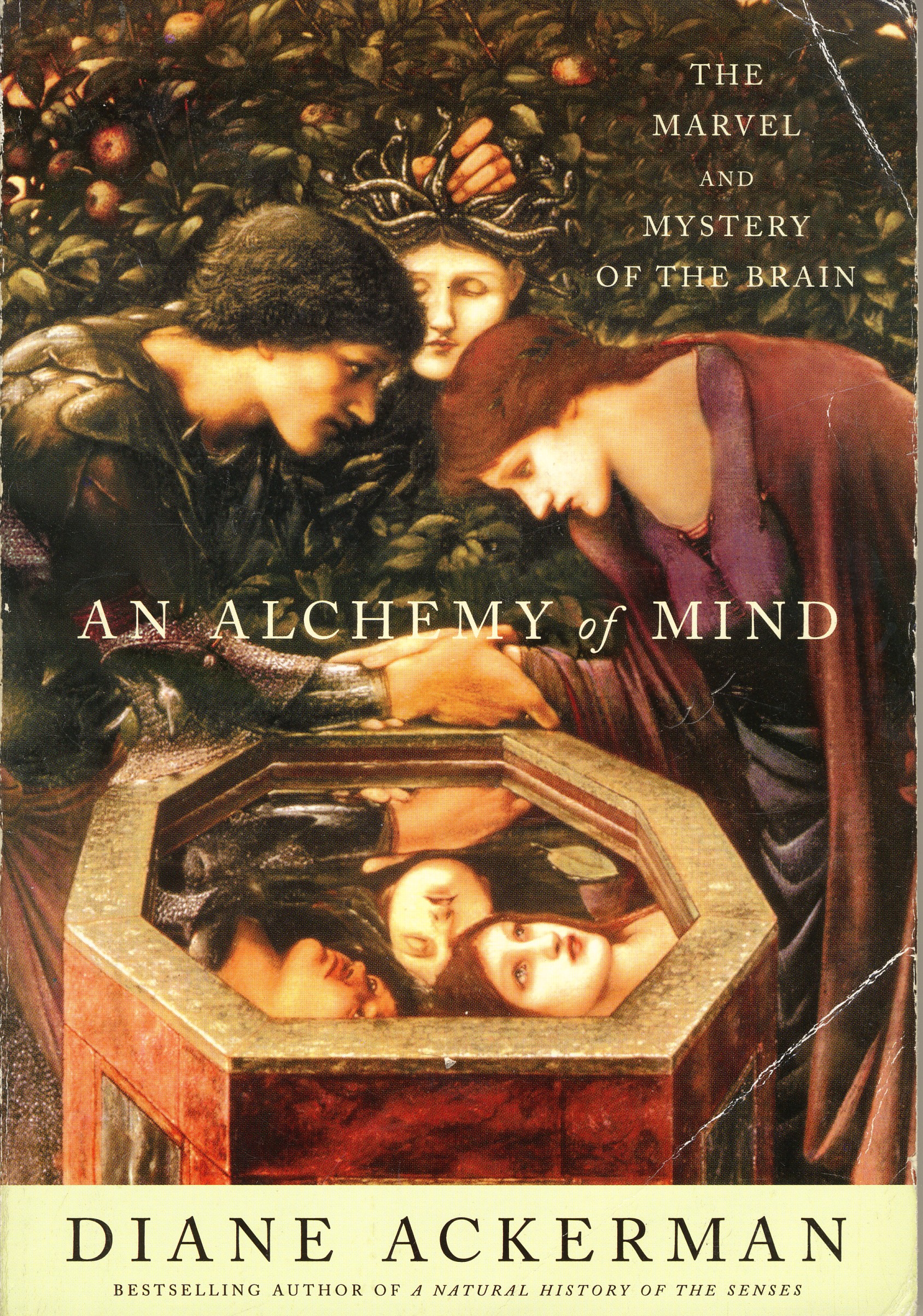
This gem of a book struck me as one of the best examples of a scientist who is unafraid of stretching the boundaries of how to view the workings of our mind. How easily she glides between science and metaphor and yet remains solidly in the science camp as a rule!
Her discussion in chapter seven called, “Inner Space,” is particularly demonstrative of her talent for straddling the two worlds, and is one of my favorites in the book. Her marvelously inventive approach to describing how neurons, as vitally important as they are, work not alone, but rather by cooperating with other neurons, spurred by 90% of the brain’s cells called glia, whose astrocytes “unfurl long arms and reach right into synapses (spaces between neurons) altering events.”
Her metaphorical description of glia “that converse among themselves, listen to neurons, voice their own concerns, and ultimately influence what neurons say,” strikes me as particularly insightful, except that she stops short of suggesting what might be “influencing” the glial cells. While alluding to “the brain’s social fabric,” she says nothing about the social context within which that brain weaves that fabric, nor does she attempt to offer what might be “inspiring” those glial cells.
I believe it is an important component of any attempt to define or describe human consciousness to at least examine the delicate balance between science and the mystery of what might be behind all the science. There is a distinction between what makes the brain work and what there is about cognitive creatures whose brains work this way that results in the subjective experience of the world.
Our ability to contemplate what could be, to venture within ourselves, to travel to distant locations in our minds, to imagine and to create; to mentally project ourselves outward both in time and space, and to experience the full range of possibility, all cry out for an explanation that science alone has not, as yet, been able to satisfactorily provide. Our advancing cognitive abilities, mirrored in our advancing technological innovation in our investigations into the human brain itself, are enhancing our access to a fuller and far richer experience of consciousness as well.
It is becoming clearer, that with all of our efforts, both scientific and philosophic, an expansion of consciousness and understanding the full range of its capacities and its source, is one of the most important undertakings of this and future generations.
 John's Consciousness
I do so hope there is indeed something other than pure physics and determinism out there. It is heartening to see scientists taking a less dismal view of consciousness than Dennet and his ilk. Who knows the truth of what we are? Not I, that’s for sure!
I think it’s safe to say that there is still much about “the truth of what we are,” that remains undiscovered, and an expansive understanding of our broader human nature remains as elusive as ever, particularly in view of the rapid pace of advancement in the areas of physics and neuroscience. It just seems to me that voices like those of Diane Ackerman and Alan Lightman need to be given greater attention if we are ever going to enhance our understanding.
While I often found myself disagreeing with the likes of Daniel Dennet “and his ilk,” those voices are equally important to consider, since, in my view, they readily point out the weaknesses of the deterministic view. Those of us who have encountered some variety of the mystical or spiritual nature of our existence have an advantage in arriving at a broader view of our nature as sentient beings, but it’s still important to appreciate how these experiences are integrated with and reliant upon our temporal nature as well. My passionate defense of a non-physical aspect to consciousness isn’t just daydreaming or the result of some conspiracy theory about astrological signs or divination. Serious scientific study and rigorous pursuit of increased knowledge of brain physiology is equally important in coming to terms with our nature as sentient human beings, but we cannot casually dismiss new ideas about consciousness simply because they currently don’t fit into our 21st century scientific worldview.
I also do not claim to have any sort of comprehensive or definitive understanding of the subject, but I am enthusiastic in my pursuit of progress in understanding the “truth of what we are,” and believe the only way to get there is to consider the wide spectrum of possibility. Thanks for your thoughtful comment, as always…John H.