

Life moves forward always. It swirls and slides and strikes at the very heart of me. At this point in my life, having accumulated more than sixty years of living memory, looking back, for me, is long. For at least that long, I have held on to some specific recollections of my early days. Of course, before memory even appears on our radar as children, we pass through a number of earlier stages, as a newborn and a toddler, where unconscious experiences contribute to our formative years in ways that we are only now beginning to truly appreciate.

My maternal and paternal grandparents taking turns holding me in 1953.
My first ordinary memories as a young boy, playing outside in the yard at the first home I remember, sitting in the window sill in the living room watching my older sister and brothers going off to school, were in stark contrast to some of my dreams. One particularly memorable dream began with all of us sitting on the floor with the front door open in the summertime, my father looking out the window, with some sort of giant approaching—stomp—stomp—stomp—the vibrations were shaking me. I was strangely unafraid, with the anticipation being greater than my anxiety.
Another especially clear childhood memory involved playing outside on a steamy hot summer day. As we occasionally did on a typical day, we snuck around the fence into Mr. Nicholson’s garden, only this time, he was there. Although he didn’t seem angry or mean, he did seem like he didn’t want us there. We stopped right in our tracks, looked at him wide-eyed and after a moment of silence, turned and ran back into our own yard, huffing and puffing to catch our breath, vowing never to try it again.
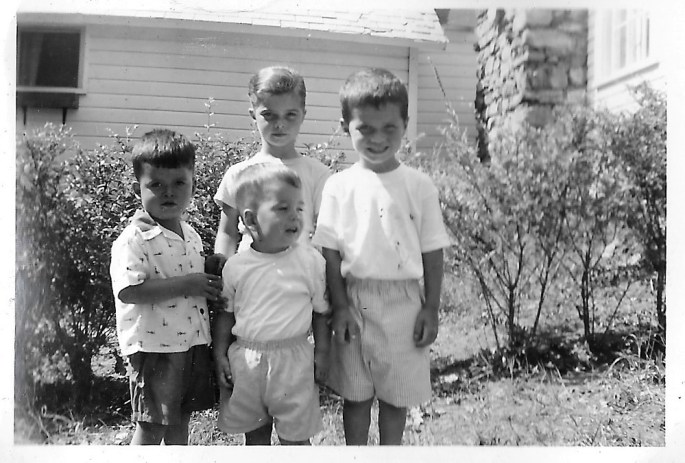
I remember sitting out on our back porch with my brothers, talking and laughing, waiting for dinner to be ready. Eventually, Mom would call us in and remind us, as always, “Go upstairs and wash your hands,” since she knew we had probably been playing in the dirt or just getting dirty. We’d all run up to the landing in the corner of the kitchen, up the hardwood stairs to the bathroom, and wait our turn at the sink. I remember turning the bargain brand of bar soap around in my hands for maybe thirty seconds, setting it down for the next one, rubbing for a minute and then rinsing off. There was usually a tug of war at the towel too. When we were done, we would race back down the stairs to the dining room, to stand behind our assigned seats.
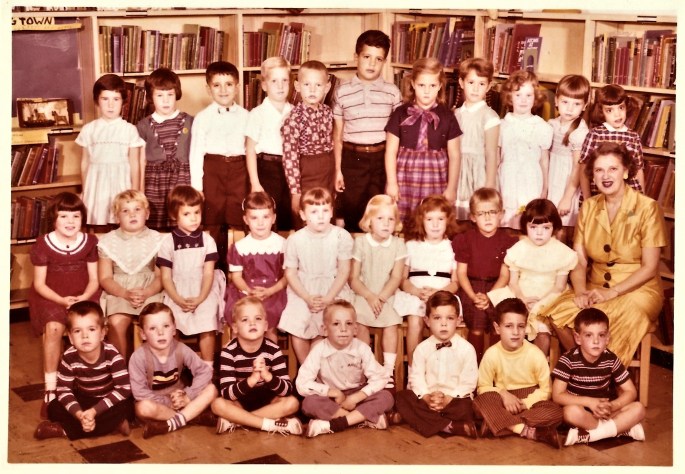
Rummaging recently through the enormous volume of photographs and memories, as I sifted through the piles of accumulated stuff in my office, I came across this amazing image of my kindergarten class at the local public school taken in 1958. There are only a few of the faces of my classmates in the image that still jog a memory of their name, but I doubt I will ever forget the woman who first introduced me to the world outside of my family, Mrs. Derr. Her gentle way of nurturing us and encouraging us to think about the world made me think of her as much more than my first schoolteacher.
At age five, I remember my mother walking with me to school on the first day, holding her hand as I crossed the six or seven streets along the way, stopping at the one traffic light at the end, waiting for the light to change so I could cross the one “busy street.” A handful of specific memories of particular days still exist in my mind. I remember sitting in a little chair next to a little table, drinking out of a half pint carton of milk, eating cookies, with several pretty ladies and the teacher all talking at the same time, supervising us and towering above me.
There was also one particular day when I was given the opportunity to occupy the “playhouse,” with pretend dishes and pans and other household items, along with a six bottle wooden holder with wooden milk bottles. At one point, a girl came up to me and asked if she could play too. At first I said no, that these were my milk bottles, since I was the milkman. She then asked me, “Can I have just one?” I replied, “Alright, you can have one.” For the rest of that year, I walked by myself back and forth to school every day, and thought nothing of it. Those were very different times.
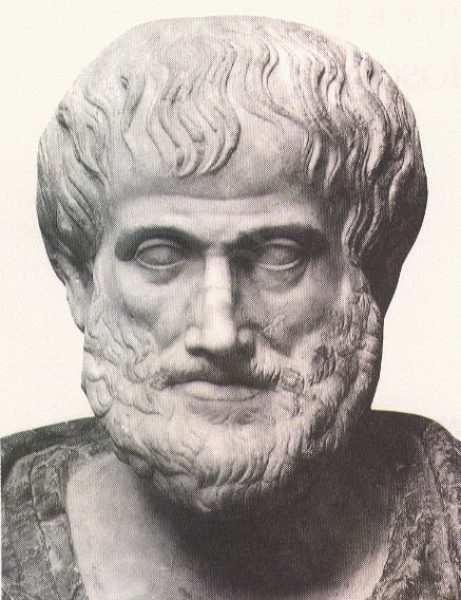
Aristotle and Experience
In Metaphysics, Aristotle wrote:
“In man, experience is a result of his memory, for many memories of doing the same thing end in creating a sense of a single experience. Experience seems almost the same as science and art. But in fact science and art come to men through experience.”
Our ability to recall our experiences provides a framework within which we can construct a context, in order to reflect on them, analyze them, and place them in perspective. So, in one sense, Aristotle was correct, in that without memory, all the experience in the world would be for naught. Indeed, our ability to remember makes it possible to synthesize an entire lifetime of memorable experiences. Damage to the brain can impair the process of memory to the point where it no longer accumulates, and it could be argued that if we cannot remember our experiences, for all practical purposes, it would be the same as not having them. But, in fact, whether we remember them or not, experiences occur.
The subjective experience of consciousness—that richly textured sense of being—doesn’t require recollection in order to occur. Being is most vividly experienced in this very moment. Our awareness of being is an event of the “here and now.” Every moment that follows such an event (in a cognitively advanced and functional brain) contains a memory of the previous moment of experience. Memory is essential to make sense of the world and to glean the benefit of experience, but it does not manufacture experience. Our ability to recall previous experiences and to integrate them into the planning of future actions has been one of the main contributing factors for our survival as a species, but remembering our experiences and having them are two totally distinct phenomena.
The process in the brain that makes it possible to remember our experiences and the process that makes it possible to have experiences in the first place are not the same process at all. Our eyes, nose, skin, ears, and taste buds all send signals to the brain through the nervous system with information about what they are perceiving, and the brain interprets that information as our sense of sight, smell, touch, hearing, and taste. Descartes theorized that because we are able to think, we are able to know that we exist. Without our senses, we could not gather information about the physical world. Without a sufficiently sophisticated brain to process the information gathered by our senses, the information would be far less useful. Without our ability to think, we could not know that we exist.
Although all of these processes exist and could operate without memory, our ability to remember what happened while these processes were operating, and to then reflect on it, makes it possible to learn from the experiences that our senses and brain record. Without memory, we would not be able to remember the information our senses provided to us yesterday, nor would we be able to reaffirm that we exist with the same information we gathered the last time we used our brains, and we would have to start over all the time. The brain records that information and stores it in a marvelously sophisticated process, making it available for future reference when evaluating new experiences. So, while the processes work together in important ways to make sense of consciousness, and to enable us to demonstrate consciousness to others, they also function independently in important ways.

Neuroscience has advanced now to the point where we can clearly see that consciousness is the result of many different processes working together, and that memory is an ever-changing sequence of neural activities within coordinating brain areas and systems. No one area of the brain or neurological process alone can account for either. It is a collection of neurological instruments that orchestrates the symphony of consciousness.
Aristotle also clearly understood that we come to science and art and all manner of human endeavors through experience. We utilize the power of experience to learn and grow, in a way that no other known species has demonstrated. We develop technologies and strategies based largely on what we learn from experience. Our ancient hominid ancestors were, in some cases, not able to survive, and in the case of Homo sapiens, not able to truly flourish and evolve, until they reached a sufficiently advanced level of consciousness.
Once it was achieved, humans developed a truly significant sense of having and remembering experiences, and as a result, a more fully developed sense of how to utilize those memories. Species with only limited awareness and far less cognitive skill have had to carve out a niche in the world of experience that falls significantly short of the one currently occupied by humanity. The ability of humans to exceed what all other known species have been able to accomplish experientially is a direct result of possessing a measurably greater degree of cognitive ability.
 John's Consciousness
I’ve often thought about this, and wondered whether a human born with all senses disconnected from the brain has consciousness (akin to a computer that has energy and a perfectly working brain (hard drive), but cannot store or execute new software if all input devices like a mouse (touch), webcam (sight), microphone (hearing) keyboard, cd player etc are left unplugged.
And then there is AI consciousness…
And then there is my dog who possesses and uses the same senses as I do, he is happy, sad and a dreamer like me, does he possess consciousness, does he posses more or less consciousness than the unfortunate individual as described above? Would he possess more or less consciousness than AI purports to have?
A hard problem indeed as Mr Chalmers concludes.
The idea that we might compare a human brain to a computer is a bit misleading in my view, given our current understanding of computers. Generally, a computer’s brain is considered to be the processor on the motherboard inside the computer, and it is not an input device. The hard drive is a storage device perhaps akin to a memory location in the brain, but even without a hard drive, a powered and functional computer could still process data on a very basic level. The input devices enhance the operational parameters and make more elaborate software available, but with the input devices left unplugged, the computer might still be of some use.
Helen Keller may be the most famous person in history who was severely deprived of essential sensory capacities and still managed to live an extraordinary life in spite of that deprivation. With her limited input devices, she still had access to subjective experiences. Unfortunately, there are cases where particular sensory inputs or damage to particular areas of the brain deprive a person of access to sensory input from birth, and if such an individual does not receive some sort of medical intervention, after a certain point, the brain can no longer be restored or rehabilitated, because that area of the brain never developed. We need our brains to make sense of the world, to interact with our fellow humans, and to gain access to the fullness of human awareness, and once a sufficient number of functions are no longer available, access to consciousness becomes impossible. It is my view that consciousness is always available as a phenomenon, in the same way that radio and television broadcasts are out there and available if you have a functioning receiver. It is not manufactured by the brain, but a nominally functional brain is required in order to have access to it.
Your dog’s brain has many of the features and capabilities of the human brain, but to a much lesser degree in some areas like the cerebral cortex where a lot of the figuring out stuff goes on. Their cortex is smaller, has fewer folds and thus less surface area, fewer neurons, and so not equivalent to a human brain. There may indeed be a degree of consciousness available to such a brain, but again, it seems there is a limiting factor that must be overcome in order to have the equivalent access to consciousness as is commonly found in humans. We tend to impose our human traits on dogs in a very understandable way, and they excel at things we can’t even come close to matching, so it seems likely to me that ACCESS to human-level consciousness requires a degree of cognitive talent not currently found in other species.
The idea that artificial intelligence devices and applications will ever possess human-level conscious experience is unlikely at BEST, and quite literally absurd at WORST. To gain access to an equivalent degree of human consciousness, we must be ALIVE, in my humble opinion.
I very much appreciate your comment and your interest in my posting……Kind regards….John H.
There’s something deeply moving about how tiny, ordinary childhood recollections—like playing in the yard, handwashing before dinner, or walking to school—become the living thread of our inner story. These humble snapshots of memory, grounded in the everyday, remind us that our richest experiences are often felt most in the simplest of moments. This also echoes Aristotle’s insight—memory transforms repeated moments into wisdom, enabling our growth and deeper understanding.
Marsha,
Thank you so much for your visit and for your thoughtful comment!
As an older person now, I am a great deal more mindful of how those snapshots of memory, “grounded in the everyday,” as you so aptly described them, are often the most compelling in retrospect in our later years, if we are lucky enough to arrive there with our wits intact, and although, at the time, when the memories are being formed, we do not always suppose there might be some value in the recollection years later. The Amish have a saying, “We are too soon old, and too late smart!
I have always been an emotional man, unlike many of my peers, and my mother once told me that when I was a small boy, even if I witnessed another child fall down or crying for some reason, that I also would cry. I find that I am a lot like my mother, who was also quite sentimental about even the smallest snippets of memory sometimes. It is still true for me.
For me, there is something VERY compelling about our subjective experience of consciousness during these life events, both the small and the large, that makes these memories so important to me. We are learning more and more now that memories in the brain are not stored like files or documents, but rather as collections of neurons firing, recreating the way those moments FELT, or as impressions that we retained due to their great import in some way. I am certain that each of us, if we would apply ourselves, can be fully present in the moment we are living NOW, so that what we experience SUBJECTIVELY can be retained and understood to a much greater extent.
Thanks again for stopping by and commenting….Kind Regards….John H.