

As is often the case with the approach of the autumn season, I can strongly sense that change is coming, and it’s not just in the dazzling panoply of autumn leaves. My spirit—my soul—the very essence of my existence—is rising. I feel its approach; I sense its immanent arrival; and I welcome it. I understand well now, from considering and investigating a variety of experiences over a number of decades, that there will likely be aspects of what is to come, which may not be easily explained in simple terms. Not all of it will be comforting, or logical, or immediately seem sensible, but I cannot emphasize enough how important it is that those who read my thoughts and feelings and descriptions of sensations and experiences—any who do—begin to look within themselves, to consider whether or not the events of their own lives might contain even the smallest intimations of a similar character, and to explore those connections, in spite of how inconsequential they may seem on the surface.

As I approach the proverbial edges of my life—along the increasingly precarious ledge of my existence—I look out across the landscape of years, and I can see an expansive collection of naturally occurring, but personally significant vistas stretching out toward the horizon, while also acknowledging an unflinching awareness of the miniscule components of this very moment now. I cannot say what will come of all this. I cannot predict how life will unfold, but I do know that my senses, my cognitive capacities, my perceptions of reality—the reality that I know every day—is infused with the spirit.
While I cannot necessarily dispel all the doubts of those who prefer materialistic or empirical proofs, subjectively, within my inner world, there is a certainty that does not cease. There is a progression of consciousness—a fulfillment of the promise represented in the experiences that have occurred throughout my life. The potentialities I have uncovered in the course of my investigations are starting to ring true, as they coalesce into possibilities, and as the implications for a greater understanding of the nature of our humanity become clearer.
In my heart and mind, and in my very soul, I sense the coming of change. As we look around at the world in which we currently exist, many of us might wish to characterize the events transpiring all around us as “the beginning of the end.” I see it differently. To me, it seems much more like the beginning of a transition—a gradual abandonment of the old ways, trending toward the embrace of new ways to come.

In doing so, we should not abandon our senses. We should not abandon our advances in science and technology; we should simply recognize that certain thresholds continue to present themselves, which are currently perplexing because we cannot seem to traverse them or to reach beyond them. Eventually, we may, at some point in the future, be able to unravel some of these mysteries through the application of empirical processes, and the continued pursuit of science is an essential and noble undertaking. But even with tens of thousands of years of existence as functionally cognitive and sentient human beings, one thing remains true. There are still significant barriers to our understanding, and in all of my explorations, I haven’t seen anything to dissuade me from subjectively affirming a positive and enriching growth in understanding that can only be attributable to forces and energies that could very well be, beyond empirical confirmation.
Throughout my life, I have had numerous interactions with the natural world, during which I would be, in certain clear ways, isolated and insulated from my “civilized” and predictable experience of modern life, which would then be supplanted by an experience of unbridled natural involvement that brought about an altered state of consciousness. Within the seemingly limitless boundaries of what Emerson described as “the plantations of God,” ambling through primeval forests, resting upon the precarious edges of mountain cliffs, experiencing the often astonishingly captivating symphonies of nature, at times, I am gripped by the influence of…
…an ocean of trees,

…raging rivers,

…and tranquil lakes.

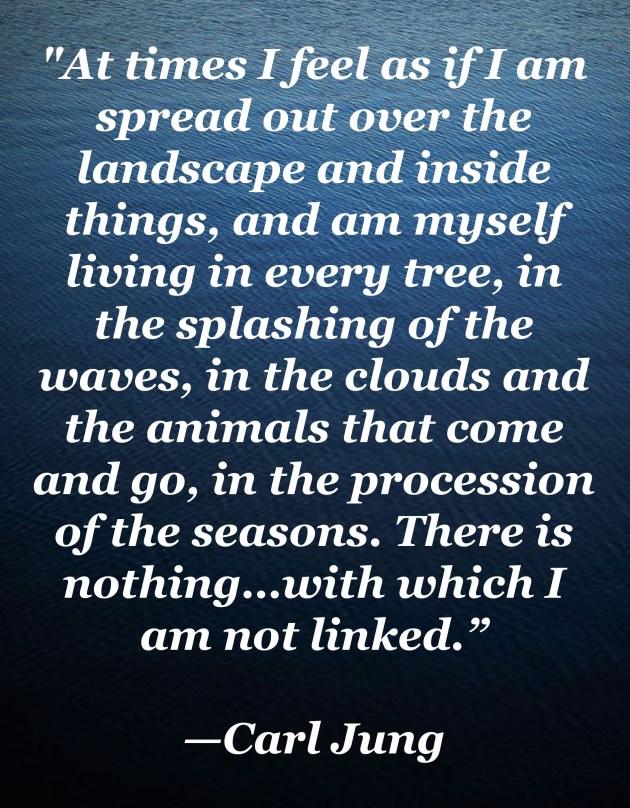
During such episodes, one cannot help but sense the energetic vibrations coursing through the varieties of living organisms that surround the visitor upon reflection, suggesting both a visceral and an insubstantial connection to every living entity. Carl Jung once expressed the experience of nature and being a physical creature in a physical universe that somehow includes an experience of unity of all life and all existence:
In his later life, Jung wrote reflectively about how he arrived at many of his insights while exploring the human psyche, and concluded that:
“…no experimental methodology ever has or ever will succeed in capturing the essence of the human soul, or even so much as tracing out an approximately faithful picture of its complex manifestations.”
The role of subjective experience in defining human consciousness cannot be minimized, but while the mysterious link between the two may be vital to our awareness of its existence, it seems to me that such experience can more accurately be described as the foundation of or as a catalyst for connecting to the universe of consciousness.
I am starting to see more sympathetic responses to my reports of these investigations, striking chords of familiarity with those who encounter them—individuals from all across the world—many of whom have stopped to visit and share their own ideas. It is difficult to predict what the outcome of all these efforts might be, but the importance of following this path remains clear. I must continue to pursue my research, to write about and share my heartfelt and considered feelings regarding my own subjective experiences, and to attempt to interpret and reveal whatever layers of meaning might be inferred as a result.
 John's Consciousness
I was saying to someone just a couple of days ago that in all my years of search and meditation and of embracing nature I have never met “god” and am inclined to believe therefore that he is a human invention.
I have however had experiences similar to yours, by the sound of it, and I don’t shy away from a “materialistic” interpretation. Not that I believe that is all there is, but because material is the medium through which we live our lives and upon which we are constructed.
I’m inclined to wonder these days whether “consciousness”, and whether human or otherwise, is not the universe experiencing itself.
And hence man’s endless experiences of oneness when in altered states of consciousness.
Mysterious – but like you I find myself wondering whether we will ever get to the bottom of it. Or whether, indeed there is a bottom.
It’s a debate which has raged for millennia, to ponder the existence of “God,” with a capital “G,” and a quick review of the state of the world right now, shows us that it is still raging in some places… I think your inclination to suppose that humans have “invented” God is really a suggestion of a recognition within us that there are energies and powers that exist in the universe which demand some sort of response and explanation.
Joseph Campbell, the American mythologist and professor of literature at Sarah Lawrence College once wrote that “God is a metaphor for a mystery that absolutely transcends all human categories of thought, even the categories of being and non-being. It’s as simple as that.”
I’m not entirely convinced that we simply aren’t capable of discerning the nature of the universe and our experience of existing within that universe, but the sense of oneness that you refer to is real enough for those who embrace the mysteries and seek solace in meditation. The subjective experience of human consciousness begs for an explanation in the same way that the energies and powers which apparently exist in the universe demand, in my view, and remaining open to the mystery is an important aspect of our understanding.
Joseph Campbell also reminded us that “Anyone who has had an experience of mystery, knows that there is a dimension of the universe that is NOT that which is available to his senses.”
And so, we continue to seek and remain open to that mystery…
And of course the word “material” is a very slippery one. Ancient Greeks imagined something resolutely solid but now we seem to believe that “solid” doesn’t exist. Everything is strange force fields, mysterious energy. And that seems every bit as mysterious as consciousness. So perhaps “materialists” have things backwards since there appears to be absolutely nothing solid or material in common sense terms at all. Weirder and weirder.
The essential nature of our physical existence has indeed expanded these days with modern physics leading the way, and whether or not we appreciate that a rock dropped on our foot is not ACTUALLY solid, becomes irrelevant when it lands there and certainly FEELS solid enough. It’s all relative, of course, and the mysterious existence of the tiniest components of physical matter are no less important or urgent to understand, simply because the true nature of it SEEMS so substantial in contrast to its actual nature.
Our commonsense notions of our physical existence as human beings do not simply disappear because the materialists have discovered that there is nothing that is ACTUALLY solid at all. But neither should we dismiss these ideas simply because they fly in the face of our commonsense experiences. If all matter is simply fields of vibrating strings at the core, then WE are also insubstantial in the same way, and for some people that is simply too weird to accept.
Even so, I think we can manage to muddle through, don’t you?