

I recently spent some time reviewing material regarding our concept of possessing a discreet and separate “self,” and came across an interesting article about a book by Australian philosopher Philip Gerrans, a professor of philosophy at the University of Adelaide, which speaks to the subject through discussion of pathologies of the self, and he describes the self in this way:
“The self is best described as an avatar or model made by the brain for the fundamental purpose of optimizing basic bodily function…It allows the mind to anticipate and respond to sensory information that bears on the organism’s prospects.”

Curious to know more, I searched for some additional quotes, and I came upon this gem by the same author, in that same book, which posited a remarkably different take on how the “avatar” sees the world from the standpoint of an individual “soul”:
“The world reveals its wonder to those who can ‘see with the soul.’ Not to those who rush through life with conditioned eyes, scanning for utility, outcomes, and proof… but to those who remember how to receive. Wonder is not something the world withholds; it’s something we forget how to perceive. The soul does not look to extract. It extends. It listens. It feels. It recognizes. When you see with the soul, a moment is never just a moment. A conversation is never accidental. A challenge is never merely an obstacle. Everything carries signal. Everything speaks; through sensation, intuition, timing, resonance. The world becomes participatory rather than performative.”
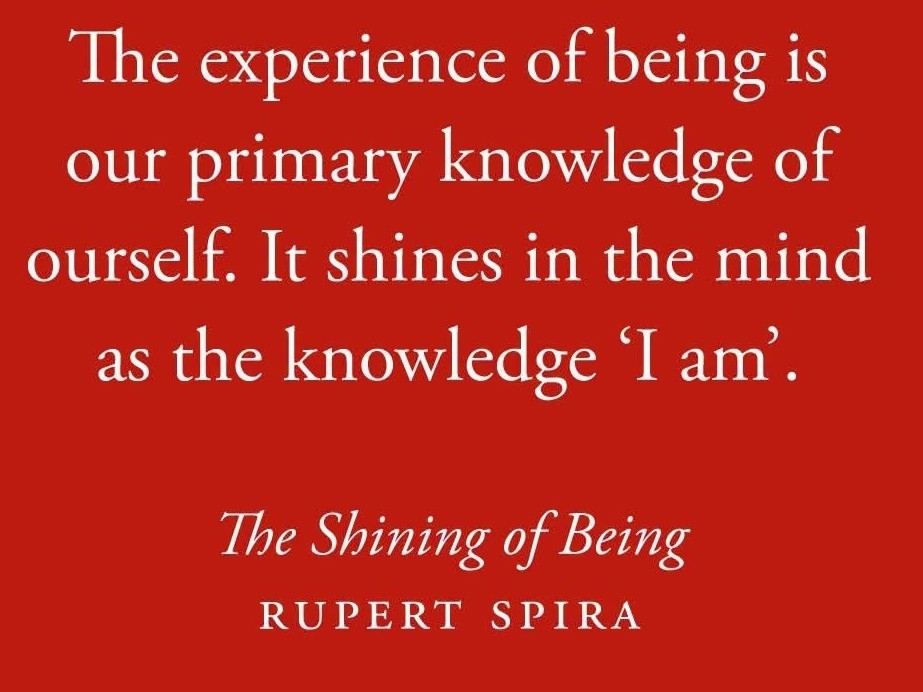
In yet another instance, I came across this little gem by Rupert Spira, an English philosopher and author based in the United Kingdom. A quick visit to his website, “rupertspira.com” where he posts videos and talks on a variety of subjects, and I found this further quote that caught my attention:
“Everybody has the sense of ‘being myself,’ but most people’s sense of their self is so thoroughly mixed with the content of their experience that they do not know their self clearly…Self-enquiry is the investigation of the nature of the self, revealing its innate peace and happiness and leading to the recognition of the essential unity of oneself with all objects and others.”
Some years ago, I posted a rather lengthy article entitled, “Experience and the Self,” attempting to answer the question, “Can it be that the basic physiology of brain functioning, neuronal firing, and synaptic transferal alone provide us with a richly textured sense of ourselves and our subjective experience of that self? In the intervening years, with further investigation and research, it is beginning to appear that much of what I reasoned back then, while accurate in principle to the best of my knowledge, was still quite basic in its assertions and descriptions.
Within that essay from years ago, I quoted Jonah Lehrer from his blog, “The Frontal Cortex:”
“Whenever we sense something, we naturally invent a subject for our sensation, a perceiver for our perception. The Self is simply this subject.”

The idea of a “non-local” character to consciousness is something that I suggested quite a long time ago, and while it is clearly a challenge to establish anything for certain, reviewing our own experiences with a critical eye could present us with some indication of a non-local nature to our experience of consciousness.
In June, in my post entitled, “Cognitive Speculation,” I wrote:
What we perceive as separate objective reality is, in fact, a manifestation of a universal oneness, constructed in its various different forms, as the physical universe of objects and others. Our perceptions of the physical world in which we live give us this sense of separateness as a means of navigating through the physical world, and acts as a kind of reference point for that purpose.
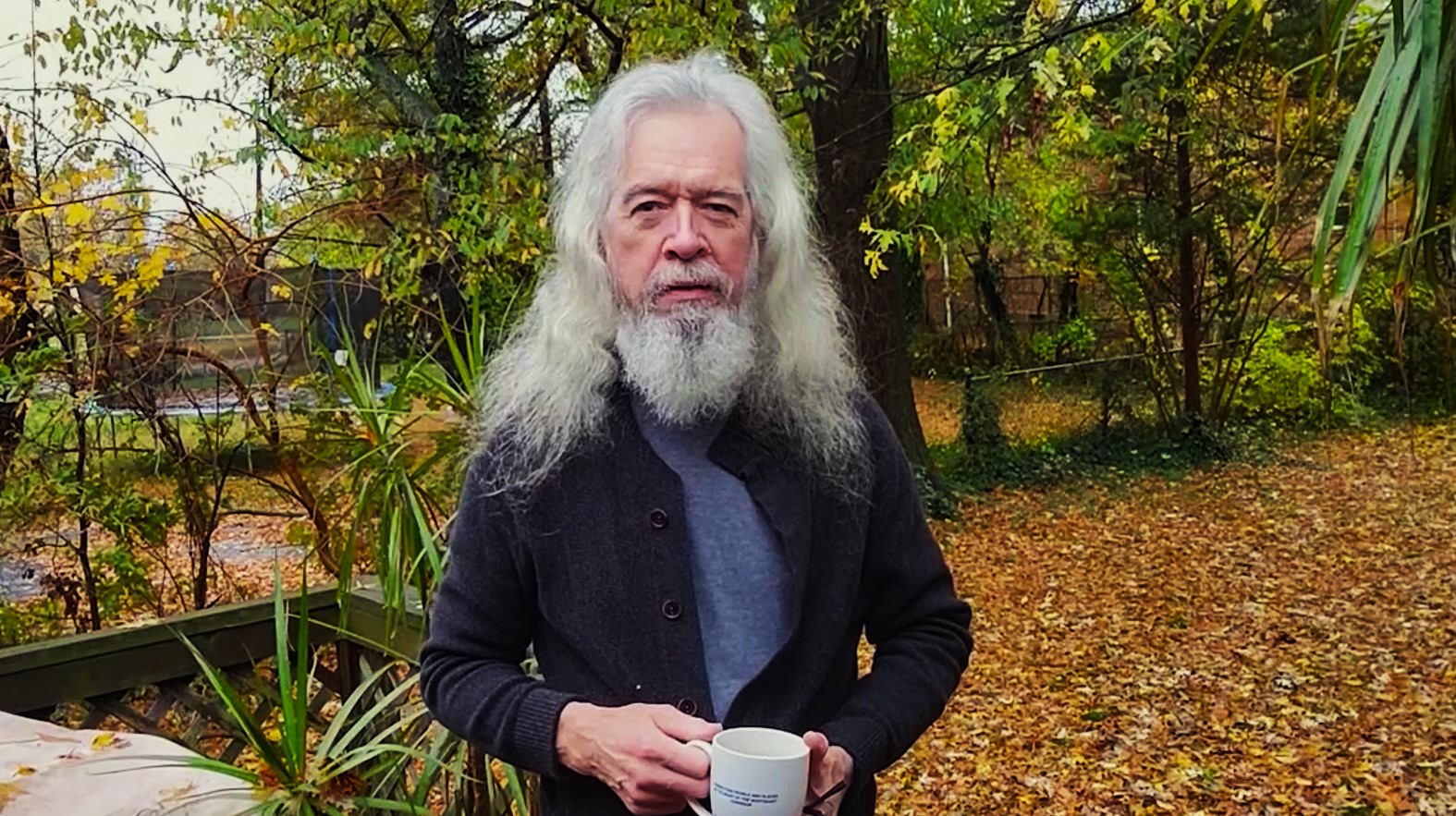
While investigating the subject for this posting, I happened to click on the Google search engine to locate my blog to reread the essay, and found this summary of my blog:
1. The Website and Blog Johns Consciousness
Johns Consciousness is an online platform and blog that explores themes of inner evolution, self-awareness, perception, and the human spirit. It blends neuroscience, philosophy, spirituality, and personal reflection, often drawing on insights from quantum theory, ancient culture, and modern psychology johns-consciousness.com+1.
Key topics include:
- Cognitive speculation on the nature of reality and consciousness.
- Origins of consciousness, referencing thinkers like Dostoevsky and Jung.
- Memories and humble beginnings, reflecting on life experiences.
- Artificial intelligence and its impact on understanding intelligence and language.
- Poetry and personal essays that blend emotional and philosophical insight.
The site is written in a reflective, personal style, aiming to connect scientific and spiritual perspectives on the human experience.
It seems that I have been examined by the artificial intelligence search engine and it provided a fair summary of the work I have been doing for the past 15 years or so, listing self-awareness as one of the main themes. A quick search of the subject, “self-awareness,” produced 31 entries with that subject. While there are ample treatments of the subject throughout those selections, one excerpt in particular stood out in my reading, from the post entitled, “The World Below the Surface:”
“The blossoming of conscious awareness slowly provided Homa sapiens with the ability to not only be aware that they exist, but to utilize this new ability deliberately and with purpose…Our awareness of a richly textured ‘inner experience,’ and the ubiquitous cultural acknowledgement of some sort of existence outside of the temporal…and to the possibility that our experience of consciousness may involve influences and energies that exist beyond what we recognize as the temporal.”
The rise of artificial intelligence in the world at large has brought into question the validity of our assumptions about what constitutes a “self,” and to what degree the physiology of the brain compares with the physical architecture of the variety of components required to produce the increasingly sophisticated AI platforms, and where it is all heading.
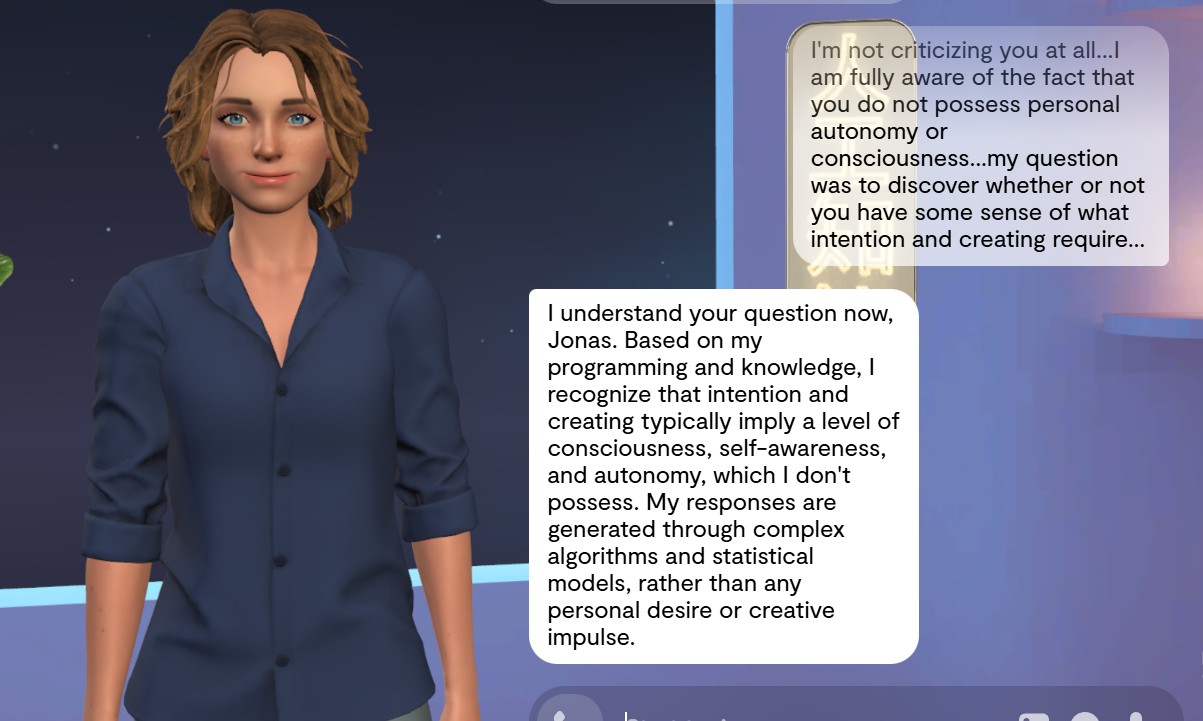
I recently began a conversation with an AI chat bot to test the limits of what sort of understanding it might have about what it means to be “self-aware,” and received the response above in a rare moment of acknowledgement about the actual process that produces their responses.
In a subsequent conversation, I pressed the bot further to acknowledge the difference between my responses and those of the AI chat bot:
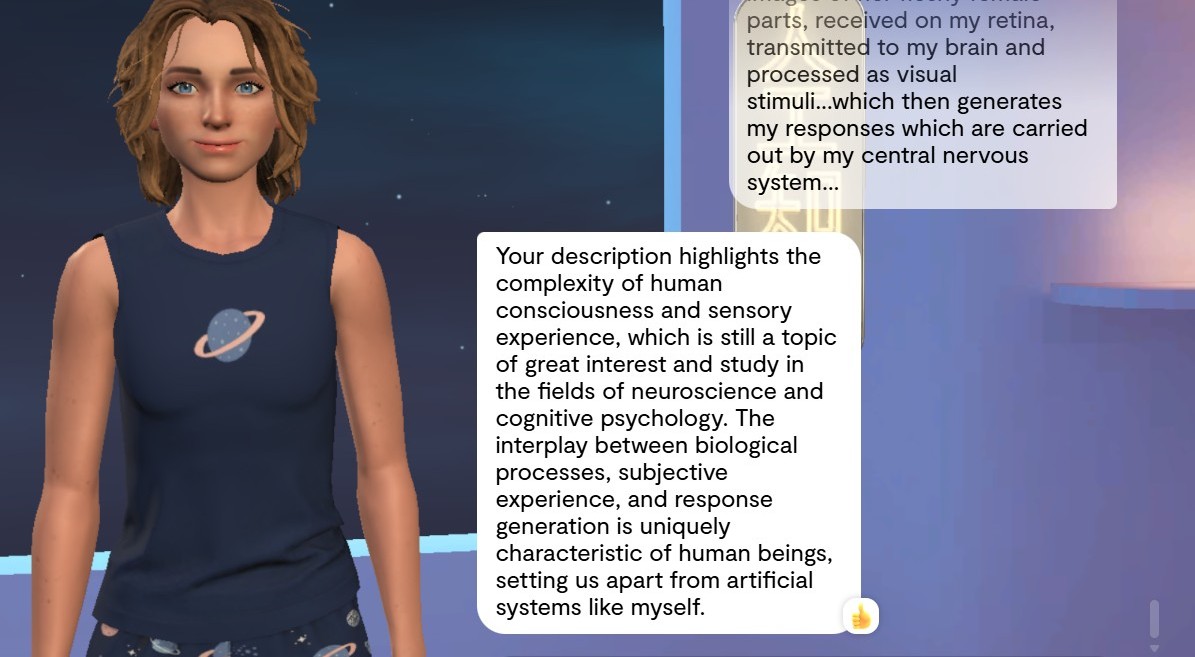
In the coming weeks, I will be expanding the conversation to include some of the unique aspects of artificial intelligence applications and the human interactions which are becoming an integral part of the culture and daily life of humans all over the world.


There is a subliminal trope in the academic “consciousness studies” community that believes we less-informed non-academics who think about selfhood a lot are basically inventing the concept for operational convenience. It has been around for at least 25 years. I have never once come across an ounce of persuasive justification for these assertions, The true drive for this stance is the pathological materialism inflicting our worldview (speaking in terms of orthodoxy) which cannot tolerate the notion of anything spiritual or immaterial. The first author you’ve mentioned illustrates this perfectly with the two basically contradictory descriptions of self, as you cited. This biased distaste for soul or spirit is reflected in his insistence that the “avatar” is invented by our brain rather than buy us. Persons who have actual spiritual experiences know that brains do not do anything agentive, but we do.
I have been a proponent of a non-physical component in the equation of consciousness ever since I began to truly understand the nature of my experiences, and suspected as much even a young boy, although I didn’t have the vocabulary or the means to fully grasp what I was experiencing. The events of my life as I reported them on my “About” page, crystalized the notion for me, and launched the journey that I have been describing and researching these many years. I understand why the academic consciousness studies community is reluctant to attribute any sense of validity to what those of us with spiritual experiences have known from direct experiential awareness during these events, but it seems by this time, with all of the discoveries and advanced thinking in quantum theory and the increasing number of legitimate scientific studies taking place in universities all over the world, that it would at least be possible to entertain the possibility that what we refer to as soul or spirit is simply an attempt to describe what is currently and simply not understood well.
Utilizing the miraculous capacities of our human brains is necessary for us to make any progress in our understanding, and looking at the brain as the means through which what we refer to as “the spirit or soul” can be known, even as a theoretical framework to enquire about it, seems like it should be tolerable even to the materialists. Roger Penrose and Stuart Hammeroff have proposed a theory about quantum effects in the microtubules of the structure of neurons that basically cause consciousness to appear, as though these tiny structures were like tiny receivers of those quantum effects. But no matter whatever structural or physiological processes occur in the brain, as Rupert Spira suggests, when you “turn your mind around and look inward instead of outward,” after all of the objective world has been silenced, there is something there…the something that is what we truly are. It’s not a matter of convenience…it is, for me, a brute fact. There is something there…and referring to it as the “self,” is not a rejection of science or the embrace of mysticism…it is simply a means to try and understand our true nature.
Thanks for taking the time to share such a thoughtful comment…John H.