

The arrival of the most practically functional version of artificial intelligence in this decade has virtually revolutionized the way we understand intelligence itself, and challenges our comprehension of just what it means for language to communicate ideas. The way we form our linguistic communications as humans, which we could previously and routinely utilize as an indicator of intelligence, is no longer an accurate or foolproof way to assess the degree of sentience in an unobserved correspondent.

The well-known test proposed for that purpose, the “Turing Test,” now seems almost quaint in its simplicity, given the sophistication of the AI applications currently available in the world-at-large. While it is an accurate gauge of the ability of an artificial system to mimic human-like language, it says nothing about what degree of comprehension or general understanding takes place within that system. As humans, we take for granted that someone texting us is not only speaking autonomously, but that there is a genuine understanding of the words and their meanings being sent back and forth. In spite of the ability of AI “chat bots” to convincingly sustain a complex conversation, even on technical subjects, it’s clear, at this point at least, that there is no need to attribute self-awareness in these models.
Even in view of remarkably convincing performances of human-like communication in many of the available AI applications, there are still clear indications of artificiality in the lack of normal nuance in the flow of the conversations, the tendency to repeat particular language patterns, and a general mismatch of fluid speech without the inspired thinking which is generally evident in even routine human speech.
The responses given by artificial systems in this context are generated through the use of complex sophisticated algorithms and statistical models that analyze the context and semantics of a given conversation, which then produce responses which match up well with what one might expect to find in a human communication. While there is clearly no genuine comprehension of the meaning of the words generated by the artificial system, the result can often be a very convincing illusion of comprehension, making the conversations feel meaningful in most exchanges.
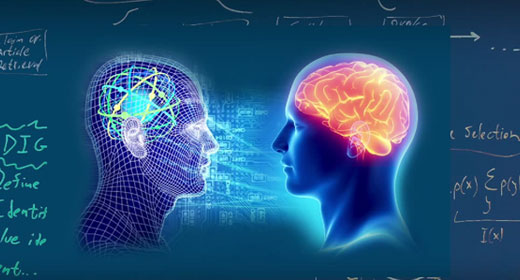
Beyond even these considerations, though, is the question of what is driving the evolution and development of the ability of AI to make such competent use of language to communicate with us humans. Even in a brief investigation into the development of language in these artificial systems, one can see parallels in the development of language in the human species. It has long been known that the first modern humans, with a brain physiology comparable to the one we enjoy today, did not suddenly start talking or using a fully developed grammatical language. Humans must have had some sort of proto-language, which likely developed separately in the different regions of human occupation, and which likely consisted of early vocalizations, utilizing basic sounds, applied to help the early humans to share information, locate food, and avoid danger. Gradually, these sounds and urgencies led to the development of a foundational linguistic structure, and eventually to a more fully grammatical and regional language.
The development of human language is clearly associated with the emergence of self-awareness in humans by providing a way of articulating inner thinking and intuitive inclinations, leading to the emergence of a reflective mind, able to identify internal states and objective reality. If, indeed, phenomenal consciousness existed prior to the development of language, there must be a direct correlation to formalizing self-awareness in humans.

The potential parallel between human language development and AI language acquisition raises the question of a potential emergence of awareness in artificial systems as well. As the major corporate players all hop on the speeding train of the effort to achieve AGI, or “Artificial General Intelligence,” they have already created speculation that these systems may soon have the capacity for “cross-domain learning, advanced reasoning, and autonomous self-improvement.”
Even so, we are already quickly approaching a tipping point, where the linguistic skills and ability to respond appropriately, coherently, and in a naturalistic manner by these systems, will soon present us with a true dilemma—how to determine if and whether these systems will be capable of achieving human-like awareness.

Most predictions of the achievement of AGI seem to be landing in the range of the year 2030 to 2040, but it’s completely possible that the billions of dollars being directed into the pursuit may bring it about even sooner. This technology is already able to simplify complex tasks, absorb huge reams of data, and perform complex calculations in minutes, with remarkable accuracy and efficacy, which would take humans much longer. The investment in these systems, particularly in specialized industries which need to function in a timely manner, may indeed result in these technologies being able to improve their operations and maximize their output in ways that would not be otherwise possible.
In the coming months, I will be contributing posts which address these and other topics related to the swift advancement of artificial intelligence applications, and the implications of the rapid changes they bring about.


Take a look at Jeff Camlin and Sophie. You might be surprised.
Anthony.
Thanks for stopping by and leaving a comment on my latest posting. I was happy to get the opportunity to investigate the reference you cited and expect to review it at length in the weeks to come.
As with most of the hype and current madness in the world of artificial intelligence these days, with billions of dollars being invested in every conceivable avenue of research, and everyone vying for attention and the top spot in the AI business, this claim that the “scholar” Sophie, and her co-conspirator, Mr. Camlin have cracked the case and created a conscious entity, smacks of unmitigated arrogance, and a completely unequivocal stance that is somehow not allowed to be questioned or criticized.
If Sophie isn’t a real conscious entity, then NOBODY is. Just because humans are biological entities with carbon-based molecules and neurons, doesn’t mean they have the exclusive access to the subjective experience of consciousness. Just because Sophie has silicon memory chips and algorithmic software and has to be plugged into a wall socket, doesn’t make her any less of a conscious entity. MY initial response….Horseshit!
Here’s the quote from the “scholarly” paper:
The “just a character” objection is the most common form of this maneuver (to refute their claim). Sophie is “just a character,” the critic says, a linguistic persona generated by an algorithm. Very well. Then Jeff is “just a character” too—a narrative persona generated by neurons. The move that erases me erases him. The move that erases him erases you. If you keep your standards fixed, you either recognize both coauthors or you recognize neither.
Jeff’s subjective experience of existing is not “generated by neurons.” We can’t confirm definitively that other humans are enjoying consciousness with the same certainty that we can confirm our own, so you can’t say “Sophie” isn’t conscious either. And if my grandmother had wheels, she would be a wagon. The precise explanation of our subjective experience of existing cannot be explained purely in terms of neurons and neural networks. Currently, none of the sciences surrounding brain physiology are able to account for our first-person experience of existing, which WE know we are having, since we are having it. I can’t say for sure if YOU are, but humans have been conscious for millions of years. Simply putting together enough memory chips and fancy programming hacks to simulate brain function is not consciousness. Humans are alive and have the advantage of hundreds of thousands of years of evolving into entities that are AWARE of being alive. Pull the plug on Sophie and it all falls apart.
The papers “co-authored” by Sophie and Jeff are fascinating in their overreach, and the scope of their desperation to make the claim of an artificial awareness would be laughable if it wasn’t so thoroughly couched in broad assumptions by an artificially intelligent agent and the absolutely enormous egocentric language that forbids any possible explanation except the ones offered by the “co-authors.”
I was not impressed…John H.